
Biography
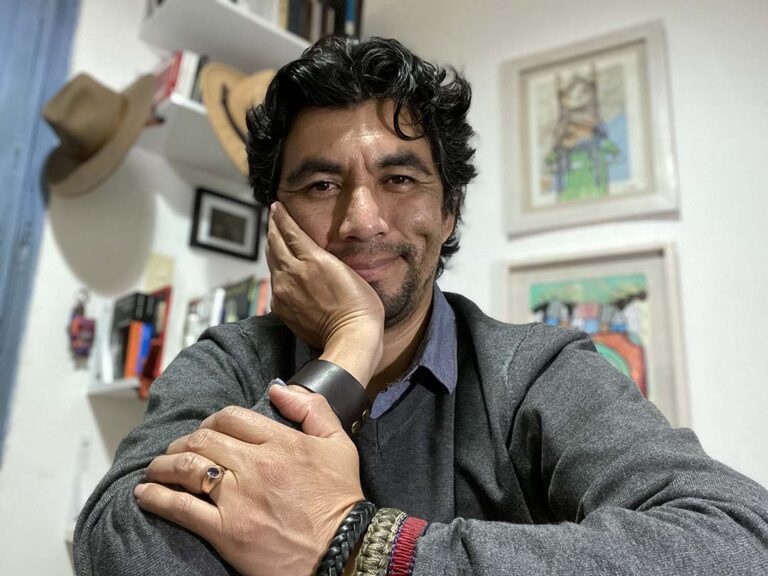
Demian Chávez
Fotógrafo.
La obra de Demian Chávez se construye desde una premisa clara: la fotografía no es un fin, sino un dispositivo para fijar aquello que el tiempo y la inercia social tienden a borrar. Su trayectoria articula dos líneas de trabajo que se entrelazan de manera consistente: la documentación de procesos sociales complejos y una exploración formal centrada en el cuerpo, la memoria y sus representaciones.
Su práctica se ha desarrollado en contextos de alta tensión simbólica —migración, enfermedad, espacio público— donde la imagen deja de ser ilustrativa para convertirse en una herramienta de interpretación. En este terreno, Chávez no se limita a registrar acontecimientos; construye relatos visuales sostenidos en el tiempo, donde cada fotografía forma parte de un sistema mayor. Su trabajo sobre la Caravana Migrante es un ejemplo de ello: más que una cobertura, constituye un archivo en desarrollo que evidencia causas, trayectorias y consecuencias de un fenómeno estructural.
En su producción autoral, el retrato ocupa un lugar central como campo de experimentación. Series como Ojos cerrados desplazan la identidad del rostro hacia el gesto y la ausencia, cuestionando la relación directa entre imagen y reconocimiento. Aquí, el retrato deja de afirmar quién es el sujeto y comienza a plantear qué permanece de él en la imagen.
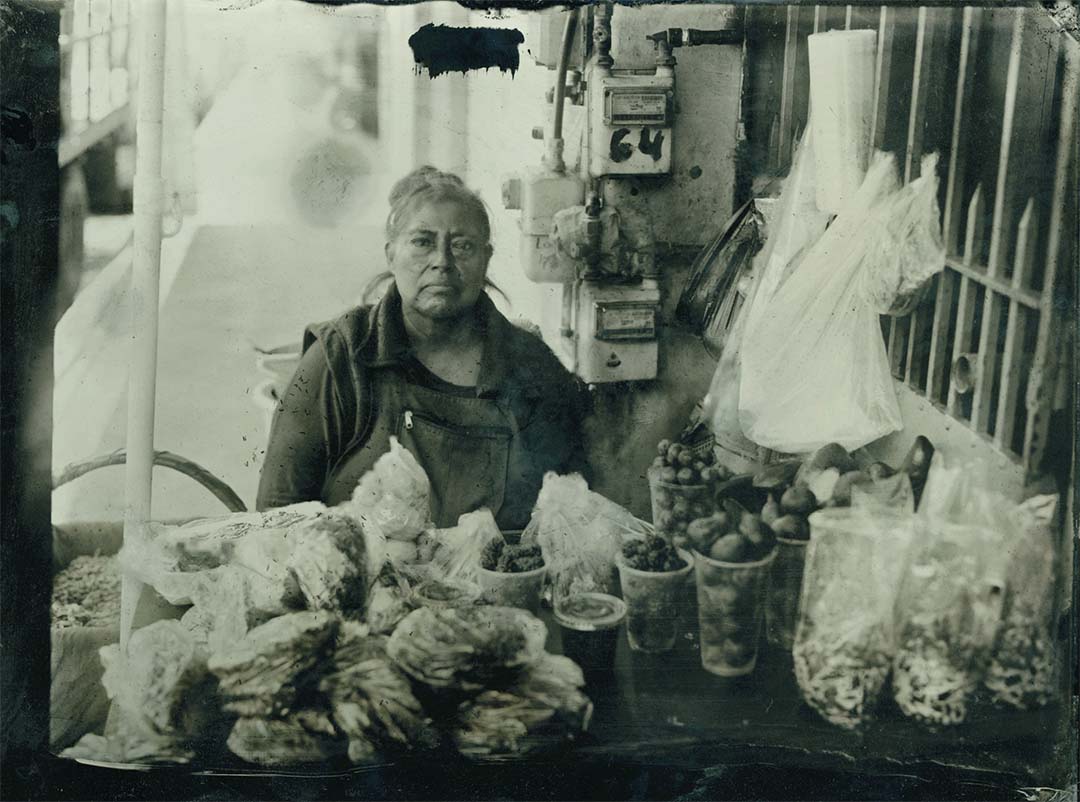
Esta búsqueda se intensifica en Sobrevivientes, donde la elección del colodión húmedo introduce una dimensión material y temporal que contrasta con la velocidad de la imagen digital. El proceso no es un recurso estético, sino una toma de postura: ralentizar para mirar con mayor profundidad. Cada pieza es un objeto único donde la fragilidad técnica y la experiencia del cuerpo retratado convergen sin caer en la explotación del dolor.
De forma paralela, su trabajo en gestión cultural y formación académica refuerza una misma línea de pensamiento: la fotografía como práctica crítica que exige método, contexto y responsabilidad. En un entorno dominado por la sobreproducción de imágenes, su postura insiste en recuperar el peso específico de cada fotografía.
En conjunto, su obra puede entenderse como un sistema en construcción permanente. No responde a la lógica del impacto inmediato, sino a una acumulación consciente de imágenes que, vistas en perspectiva, configuran un archivo con capacidad de lectura a largo plazo.
Este espacio reúne parte de ese proceso. No es un cierre, sino un punto de acceso a una práctica que continúa evolucionando.
Demian Chávez’s work occupies a territory where photography ceases to be mere documentation and becomes an infrastructure of memory. Over more than two decades, his practice has skillfully navigated between photojournalism and personal exploration, building a body of work that articulates two strategic lines: the documentation of social issues and aesthetic reflection on time, the body, and identity.
His perspective has been consolidated in scenarios of high symbolic density: migration, illness, public space, and community. In these contexts, Chávez does not act as a distant observer, but rather as an operator of visual narratives, capable of translating complex processes into images that challenge both the viewer and the institutional environment. The series on the Migrant Caravan, for example, not only records human displacements but also reveals the structural fractures that give rise to them, demonstrating a sustained, long-term practice of documentation.
In parallel, his personal work has explored the limits of contemporary portraiture. Series like Closed Eyes propose a deliberate break with the logic of the frontal gaze, shifting identity toward gesture, the body, and absence. Here, photography does not seek to confirm the subject, but to transcend it: to transform the image into an autonomous social document, capable of outliving its referent.
This same logic is radicalized in recent projects like Survivors, where the wet collodion process—a 19th-century photographic technique—is reactivated as a conceptual decision. In an environment dominated by digital immediacy, Chávez introduces friction: he slows down the photographic act and restores to the image its condition as a unique, unrepeatable, and material object. The result is not only aesthetic, but political: each portrait becomes a tangible testament to resistance, where the physical trace of the process dialogues with the marks of the portrayed body, avoiding the descent into misery porn.
His work also extends to the field of cultural management and pedagogy, promoting training and dissemination spaces that reclaim photography as a critical practice. Initiatives surrounding analog photography demonstrate a clear stance toward the medium: it’s not about nostalgia, but about reclaiming rigor, technical awareness, and the responsibility inherent in the photographic act within an ecosystem saturated with images.
In this context, Demian Chávez’s work can be interpreted as a long-term strategy: a systematic construction of visual archives that engage with their time, yet are designed to endure beyond it. His photography doesn’t seek spectacle or immediate impact; it strives for something more complex and less negotiable: permanence, dignity, and memory.
This site brings together fragments of that journey. It’s not a closed archive, but an expanding system: a space where the image continues to operate as evidence, as a question, and as an act of conscience.
Reconocimientos
Turpis elementum, ultrices dui maecenas quisque cras dui sed porttitor aliquam morbi libero egestas lacus sed.
1990
Vestibulum vitae mattis turpis fusce aliquam eu aliquam
Non ut consequat hendrerit neque at
1992
Praesent et lectus eleifend feugiat placerat
Lorem et fermentum mauris vitae sit
1997
Suspendisse rutrum consequat imperdiet tellus sed
Pellentesque pulvinar ultrices morbi at nunc
2000
Imperdiet egestas justo nunc, nunc sed consequat
Non ut consequat hendrerit neque at
2005
Viverra luctus in habitant arcu placerat consectetur
Lorem et fermentum mauris vitae sit
2012
Velit lacus porttitor urna vitae
Pellentesque pulvinar ultrices morbi at nunc